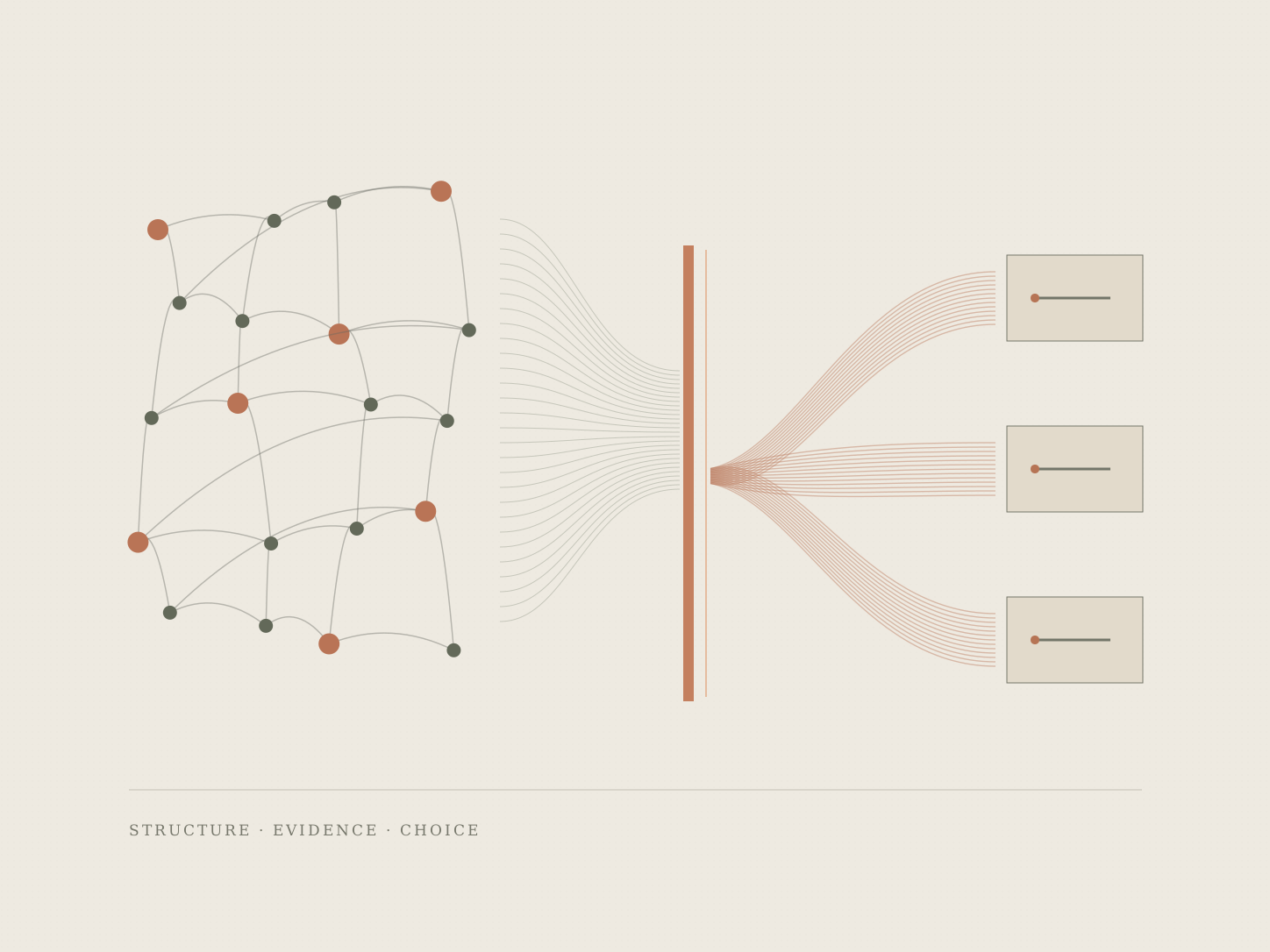
Making the choice of a solver inspectable
For an optimization problem that reveals its value only through evaluations, a more elaborate search algorithm may still leave failure unexplained. My DFO working manuscript makes the instance’s exploitable structure an explicit question before search. Part of the budget probes how variables interact and whether a low-order structure can be read; the remainder funds the solver. The aim is to return a strategy with its evidence and cost, helping distinguish a poor solver choice, an unreliable diagnosis, and a landscape that offers little usable structure.
Two views of structure, with a priced diagnosis
The study describes discrete structure through two complementary views: the Walsh spectrum captures sparse low-order relations, while an interaction graph describes variable dependence and width. The diagnosis combines flatness, spectral-order, interaction, direction, separability and structural-read probes. It charges each objective evaluation and returns labels alongside the edges, directions and read records that support them. A dispatcher can use a structural read, block-coordinate search or iterated local search, and return an undetermined or abstaining label when budget or evidence is insufficient. Width-based dynamic programming currently supports the theory and tests with a supplied decomposition; it is not fully integrated into the black-box dispatcher.
Testing whether diagnosis earns its cost
The current manuscript separates diagnosis, structural reading and final optimization on synthetic discrete problems with known structure. Comparisons charge diagnosis inside the total budget, use masks and variable permutations to remove construction shortcuts, and include controls such as the same diagnosis followed by local search regardless of its label. The reported benefit depends on the problem: a diagnosis can improve method selection, or lose that advantage through cost and misclassification. The evidence does not establish universal superiority over the strongest fixed solver. Transfer to real applications, a complete black-box width-solving route and stronger official baselines remain further work.
Discuss this research
I welcome conversations about the questions, methods, and ways to test them.
lancer20060105@gmail.com