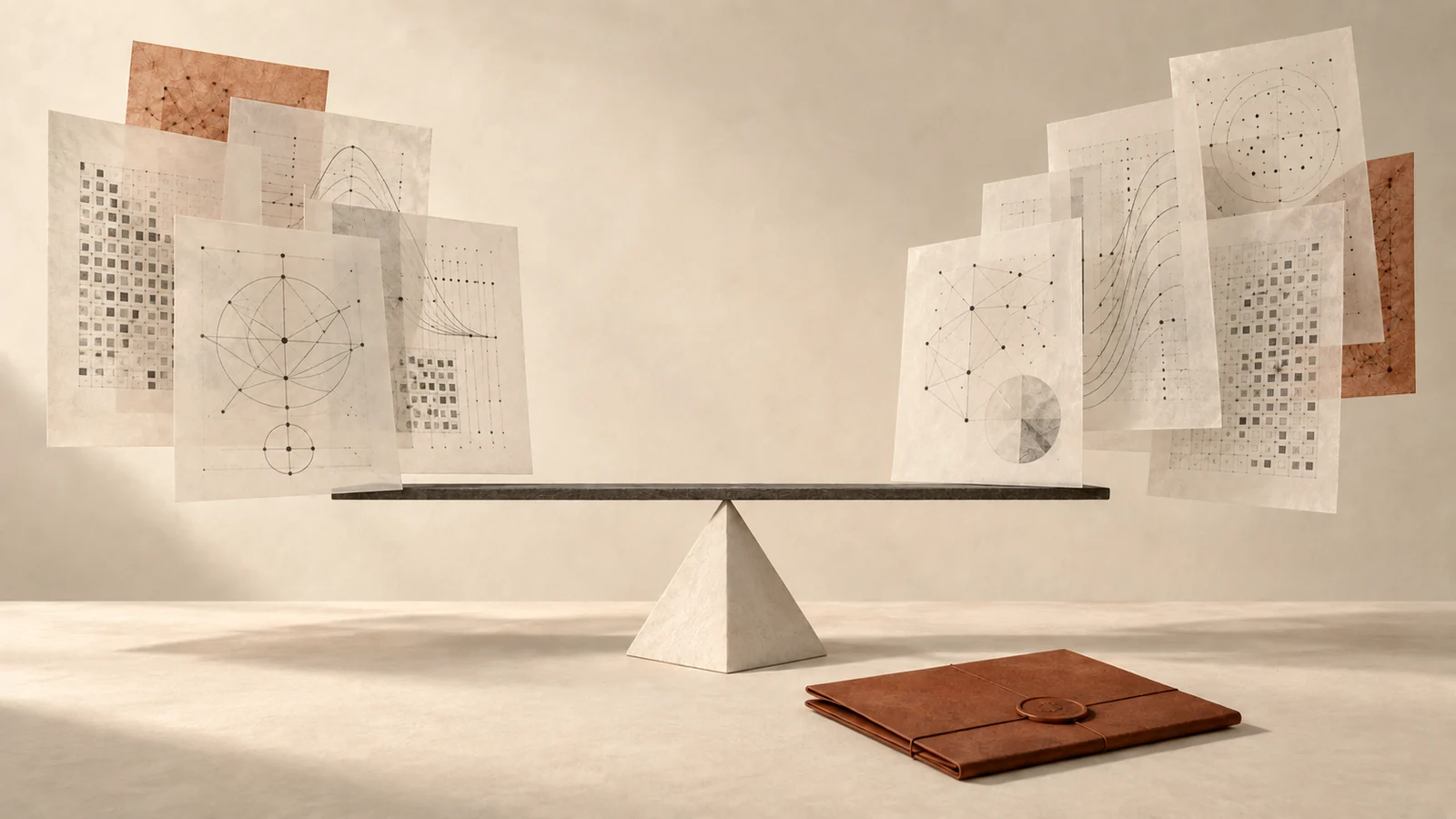
ARCHITECTURE / THEMIS
Evidence, disagreement, then judgment
- 01
Research artifact
Independent review role
- 02
Clerk
Object + lens + field
- 03
Scout
Claims + quotes + coverage
- 04
Prosecutor
Independent review role
- 05
Advocate
Independent review role
- 06
Insider
Independent review role
- 07
Blind Probe
Problem only
- 08
Schema / quote / graph / symmetry
Independent review role
- 09
Judge evidence profile
Independent review role
- 10
Deterministic score map
Independent review role
COURT / FORGE / PALATE / ATELIER
Four spaces for research judgment.
Contribution routing, independent critique, evidence profiles and separate score mapping.
Explore this part →ForgeStructured idea cards, mutation prompts, selection and the ATLAS candidate archive.
Explore this part →PalateVenue, historical and personal taste views, with six critique archetypes.
Explore this part →AtelierAuthor voice, paragraph contracts, writing and reading roles, and provenance records.
Explore this part →Evidence review, idea development, taste and expression retain separate roles. These are architecture responsibilities; real-paper end-to-end validation is the next milestone.
01 / THEMIS-COURT
Make research judgment traceable
Themis Court is the contribution-review and writing module in my AutoResearch project family. I built it around a practical question: when an idea or manuscript looks promising, how can we make the judgment traceable? The system divides that work into roles with explicit responsibilities, from choosing the right contribution lens to examining evidence and preparing a report. Its aim is to help authors decide what their work supports and what to test next.
02 / THEMIS-COURT
Route the contribution and its evidence obligations
The first step is routing. An early idea, a local module, and a complete paper carry different evidence obligations. The Clerk selects among twelve contribution lenses, including method, theory, measurement, corrective empirical work, systems, resources, and concept feasibility. It also separates four identities: what the author claims, what the work actually contributes, what a reviewer may perceive, and the strongest honest framing. This makes a benchmark’s diagnostic value or an exploratory result’s feasibility signal visible under the appropriate standard.
03 / THEMIS-COURT
Organize evidence and disagreement
The Court then organizes evidence and disagreement. A Scout extracts claims, records search coverage, and compares prior work. Independent prosecution and defense contracts challenge and support the contribution. An Insider supplies field expectations, while a blind Probe proposes mechanisms from a problem description that omits the solution. Schema checks, captured-quote verification, dependency-graph audits, and symmetry checks make those outputs inspectable. The Judge produces an evidence profile; a separate deterministic mapping produces a venue-oriented score distribution and exposes its calibration state.
04 / THEMIS-COURT
Keep value and uncertainty visible
Research value is recorded across six dimensions: novelty, rigor, utility, clarity, fertility, and correction. Keeping them separate helps explain why a useful resource, a careful negative result, or a clarifying perspective may matter. Unresolved claims remain in an epistemic ledger with decisive tests. Predictions can become dated bets, allowing later outcomes to inform retrial and precedent rather than disappear after a confident report.
05 / THEMIS-COURT
Separate taste views and invite dissent
Version 14.3 adds Palate and Atelier. Palate presents three views alongside each other: venue expectations, historical importance proxies, and the author’s preferences. Personal preference is designed for annotations and re-ranking rather than changing the underlying evidence. A Masters’ Bench uses six judgment archetypes to ask questions about simplicity, unification, decisive evidence, challenged assumptions, execution, and future growth. These are perspectives for critique, not impersonations of real scholars.
06 / THEMIS-COURT
Connect evidence to writing and idea development
Atelier connects that review process to writing. It provides author-voice statistics, paragraph contracts, writer and reader roles, a claim-contract check, and a paragraph-level provenance ledger. Forge supplies a complementary generation wing: ideas become structured cards with a mechanism, contribution lens, lineage, cost tier, and decisive test before being selected for deeper review.
07 / THEMIS-COURT
Current release and the next First Flight
The current release is v14.3.0-alpha: an offline scaffold with role protocols, schemas, deterministic tools, and smoke-test fixtures. Its real-paper First Flight remains pending. Live retrieval, substantial fitted calibration, blinded generation comparisons, and human assessment of writing quality are the next validation milestones. The module is intended for author-side self-audit, laboratory discussion, and research education. My next step is one complete real case, with evidence and uncertainty preserved throughout the record.
Outputs & scope
- Evidence profile
- Review dossier
- Idea cards and revision records
For author-side self-audit, laboratory discussion, and research education. Current checks use offline fixtures; real-paper First Flight, live retrieval, substantial calibration, and blinded evaluations remain pending.
Developed from Lancer’s V13/R44 contribution-assessment system.
These modules describe the programme’s intended division of work. Cross-module runtime connections are still being integrated and validated.
Discuss the project